TL;DR. At the invitation of Prof. Dr. Christian Klusmann, Tim and Marlene from Sleak visited Munich University of Applied Sciences (Hochschule München). In the course "Information Engineering", master's students learned how to use AI to simulate realistic B2B conversations, create their own personas and train their interviewing skills. The focus was on expert interviews for developing business models around Autonomous Mobile Robots (AMR).
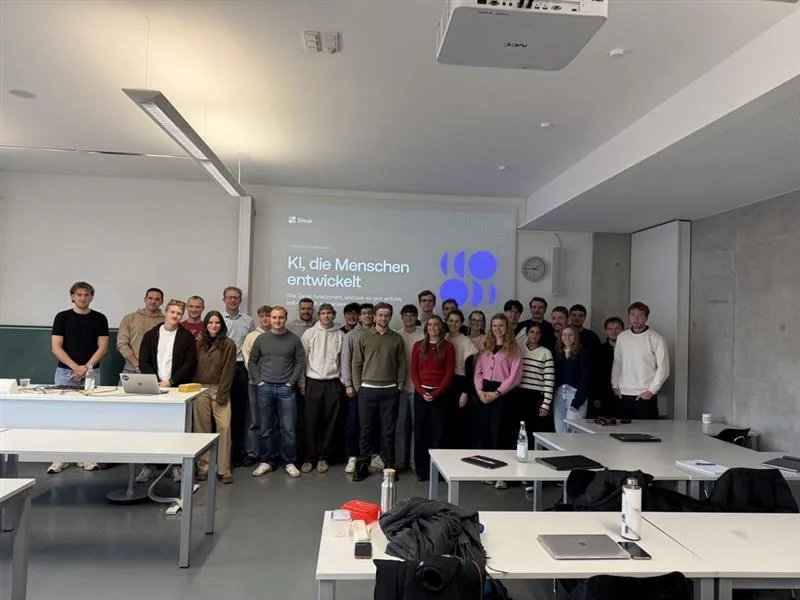
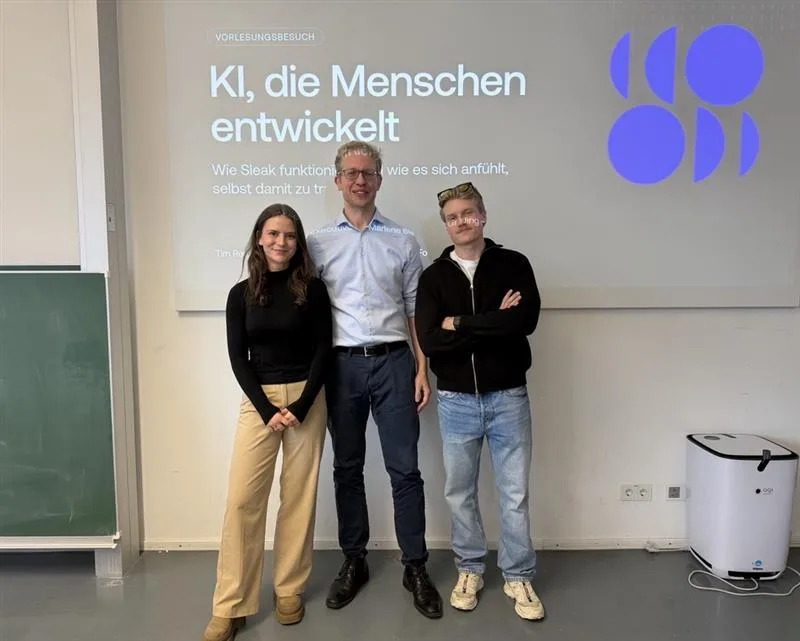
How do you prepare for demanding B2B expert interviews before facing a real customer? On 17 November 2026, Sleak was a guest at Munich University of Applied Sciences. Together with master's students, the team tested how AI simulations can support the preparation for qualitative interviews.
A Guest at Munich University of Applied Sciences
On 17 November 2026, Sleak was part of the course "Information Engineering" at Munich University of Applied Sciences. The invitation came from Prof. Dr. Christian Klusmann, Professor of Entrepreneurship and Digital Business Models.
In the course, master's students of industrial engineering develop concrete business models for use cases around Autonomous Mobile Robots (AMR).
An important part of the project work is validating their own assumptions through qualitative expert interviews. The students want to better understand market potential, the competitive landscape and the criteria behind buying and switching decisions.
The interview partners are often experts from business development or innovation management. These conversations require good preparation and a structured interview approach.
Why Expert Interviews Need Practice
A good expert interview is more than a list of prepared questions. What matters is asking the right follow-up questions, responding flexibly to answers and drawing out complex requirements in a targeted way.
For students in particular, it is not always easy to lead such conversations for the first time.
AI-supported conversation training offers a way to practice typical interview situations in advance, without the pressure of a real interview.
Getting to Know Sleak: Platform, Features and Demo
To start, Tim and Marlene introduced Sleak and what the platform can do. In a live demo, the students saw how realistic conversation situations can be simulated with AI.
The focus was on how different interview partners and conversation scenarios can be modelled, so that students can prepare specifically for real interviews.
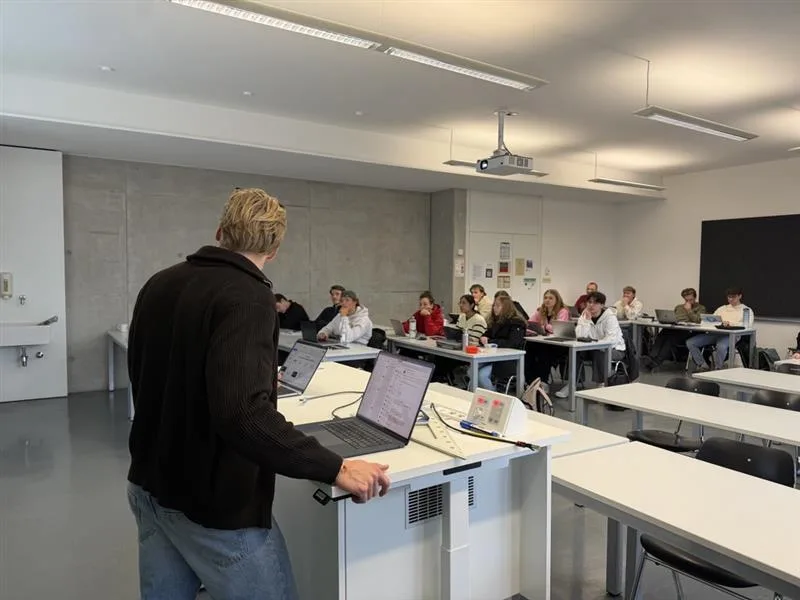
Afterwards, the students worked with Sleak themselves and got to know the platform in their own exercises.
From Prepared Scenarios to Their Own AI Personas
After the introduction came the practical part of the session. In two work phases, the students tried out different conversation situations.
First, they played through prepared scenarios. They tested their questions, experienced different conversation paths and gained experience in leading an interview.
In the second step, they created their own AI personas.
This matters especially in the AMR context. A conversation with someone from innovation management can have a different focus than an interview with a contact from business development.
With Sleak, the students built suitable interview partners for their specific assignments and then simulated the conversations.
This way, the preparation for expert interviews turned directly into practical application.
AI in University Teaching: Theory Meets Practice
The visit to Munich University of Applied Sciences shows that AI-supported conversation simulations are useful outside classic corporate settings too.
Whether in business model development, market research or customer interviews, the ability to lead good conversations and draw out relevant information is decisive in many fields.
Sleak makes it possible to simulate such situations in a safe setting and to improve one's own interviewing skills through repeated practice.
Many thanks to Prof. Dr. Christian Klusmann for the invitation and the collaboration, and to the students of Munich University of Applied Sciences for their interest and active participation!
Frequently Asked Questions
When did Sleak visit Munich University of Applied Sciences?
Sleak visited Munich University of Applied Sciences on 17 November 2026, as part of the course "Information Engineering" taught by Prof. Dr. Christian Klusmann.
What did the students practice with Sleak?
The master's students practiced B2B expert interviews for business models around Autonomous Mobile Robots. They first played through prepared scenarios and then created their own AI personas for their interview partners.
What is Sleak?
Sleak is an AI that develops employees. The AI Coach builds business-critical knowledge and conversation skills, in dialogue and in realistic practice conversations, for teams in sales, procurement, customer service, leadership and onboarding. The company was founded in Munich in 2024.